Pikmin 4 Types Guide: Abilities, Hazards and Access
Choose between nine Pikmin types by their jobs, hazard limits and documented access, with a clear distinction between cave encounters and Onions.
FAQ
Are Glow Pikmin a normal daytime choice?
Does this reference include unlock routes?
Why is there no single best Pikmin type?
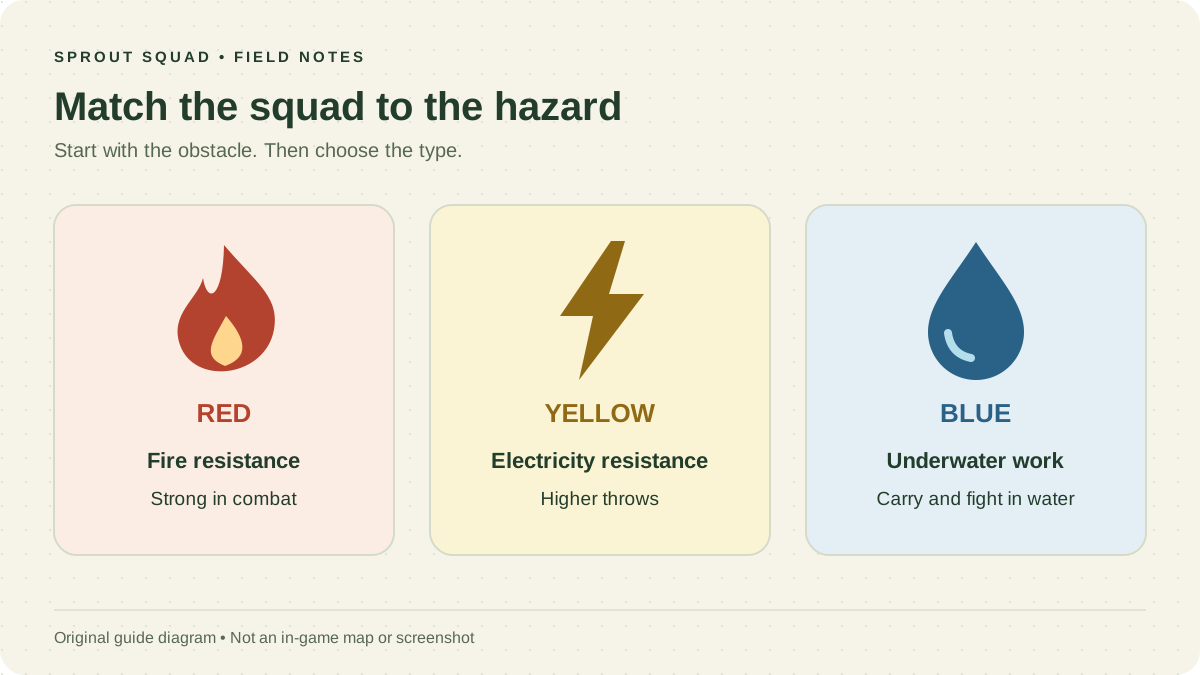
A type that wins one fight can still be the wrong choice for a blocked carrying route. Begin with the obstacle that prevents progress, reserve a slot for its solution, then choose the remaining types for the work nearby. The normal three-type selection makes opportunity cost visible: an unnecessary specialist displaces something else.
The interactive reference shows all nine types and filters them by job. Its access notes are community references; they do not promise a fixed linear unlock order.
Which abilities should you match first?
| Job | Type to consider | Important limit |
|---|---|---|
| Fire | Red | Fire resistance is not water safety. |
| Electricity or high throws | Yellow | A high throw is not flight. |
| Submerged work | Blue | Underwater work differs from crossing over water. |
| Freezing | Ice | Maintain the assigned group when relying on frozen water. |
| Crystal obstacles | Rock | Do not infer universal hazard immunity. |
| Airborne transport | Winged | Flight does not replace underwater work. |
| Heavy carrying | Purple | Strength does not erase slow movement. |
| Poison | White | Being harmful when eaten still costs the Pikmin. |
| Night expedition | Glow | This is not a normal daytime Onion squad. |
How should you build a three-type team?
Write down the first required job, the second likely job and a contingency. If all three choices do the same thing, check whether you have ignored the environment. Nintendo’s Onion suggestions are a useful baseline for an unfamiliar visit; change the recommendation when you have a specific reason supported by your map or prior attempt.
Oatchi can change the number of workers needed for carrying, so squad planning and training should be considered together. Use the Oatchi planner to compare a capacity upgrade with bringing more carriers.
Why do wild Pikmin and Onions need separate notes?
A cave can introduce a type before you have its matching Onion. The encounter gives access to that group; the Onion changes how you can grow replacements through normal surface collection. If you conflate the two, a future plan may assume a stock of specialists you cannot yet replenish. Read Onions and wild Pikmin before planning a risky cave around a small reserve.
What should you change after an unsuccessful attempt?
Identify the failure before changing every slot. Was the problem hazard resistance, carrying capacity, travel time or issuing the wrong task? A different type only helps if its ability addresses that cause. Keep one variable stable and revise one decision; otherwise you cannot tell what improved the next run. The Dandori practice guide applies the same principle to timed work.
Which sources were checked?
Verified 3 November 2026. Official confirmations and community references are labeled below. Advice is original editorial planning guidance; no personal gameplay test or optimal route is claimed.
Related Articles
exploration
Pikmin 4 Areas Guide: Where Your Adventure Takes You
Compare the six main Pikmin 4 exploration areas and use a location-first planning method for caves, treasures and return visits.
exploration
Pikmin 4 Cave Guide: Prepare, Explore and Return Safely
Prepare a Pikmin 4 cave squad, distinguish wild type access from Onion unlocks, and check each floor before moving deeper.
exploration
Pikmin 4 Treasure Guide: Collect, Check and Track
Use the Radar Map, Treasure Gauge and a local checklist to find missing Pikmin 4 treasures without confusing surface, cave and pile progress.
Was this helpful?
Thanks for the feedback!